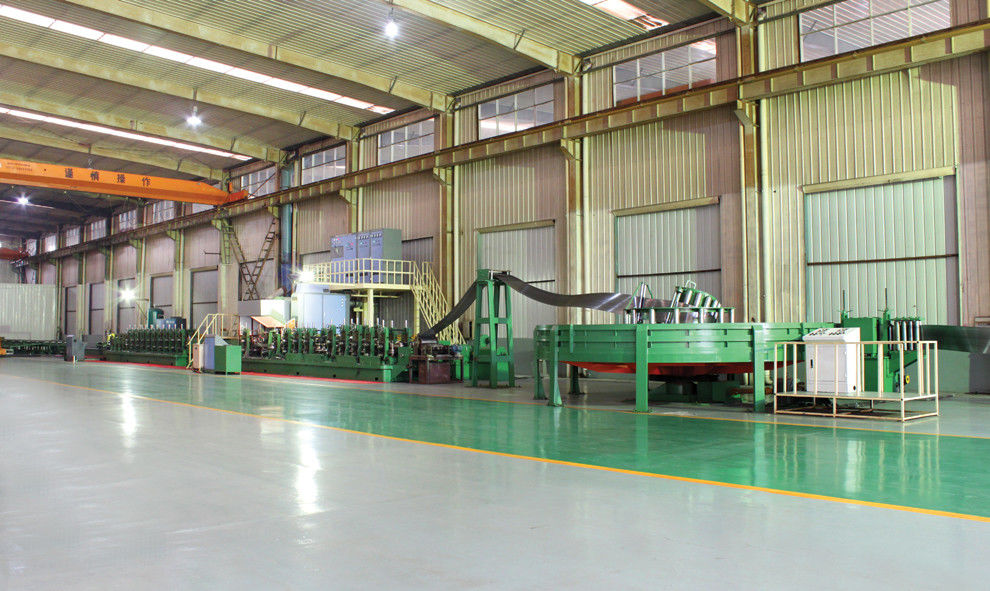
ZY-45 coated pipe, precision pipe, heat exhanger pipe welding machine line
| Raw material application |
CR steel, copper coated CR steel |
| Production OD range(mm) |
16-50.8 |
| Production thickness range(mm) |
0.7-2.0 |
| Design line speed |
110m/min |

Product Overview
The Straight Seam Pipe Welding Machine for Low Carbon Steel is designed for high-efficiency ERW welded pipe production with a production speed up to 110 m/min.
It is suitable for manufacturers producing round, square, or rectangular welded steel pipes from low carbon steel strip. The line is commonly used for construction tubes, furniture tubes, mechanical tubes, greenhouse pipes, fence pipes, and general industrial pipe production.
This machine converts steel strip into straight seam welded pipe through continuous forming, high-frequency welding, sizing, cutting, and run-out handling. It helps pipe manufacturers achieve stable pipe shape, consistent weld seam quality, and efficient continuous production.
Problem
Many pipe manufacturers do not only need a pipe welding machine. They need a production solution that can keep speed, weld quality, size accuracy, and production stability at the same time.
When production speed reaches 110 m/min, small problems can quickly become large losses. Poor strip feeding, unstable forming, inaccurate edge alignment, unsuitable welding heat, or weak sizing control may cause weld defects, pipe deformation, high scrap rate, and unstable pipe length.
For low carbon steel pipe production, buyers often ask these questions:
Can the machine run stably at high speed?
Can the weld seam remain consistent during long production?
Can the line support different pipe sizes?
Can it reduce material waste and downtime?
This page answers those questions from the production problem, technical cause, equipment solution, application, working process, and selection method.
Cause
High-speed straight seam pipe welding has several technical challenges.
First, the steel strip must enter the forming section smoothly. If the strip feeding is unstable, the pipe edge position will change, and the weld seam may shift.
Second, the forming rolls must gradually shape the strip without creating excessive stress. If the forming angle is not well designed, the pipe may have poor roundness, corner deformation, or unstable springback after welding.
Third, high-frequency welding requires accurate control of heat input and squeeze force. If welding heat is too low, the weld seam may not fully fuse. If welding heat is too high, the weld area may burn, deform, or produce excessive internal and external burr.
Fourth, at 110 m/min production speed, every section of the line must work together. The uncoiler, accumulator, forming mill, welding unit, sizing section, flying saw, and run-out table must match the same production rhythm.
The conclusion is clear: high-speed pipe production depends on the whole line design, not only on the welding unit.
Solution
This straight seam pipe welding machine provides a complete ERW pipe production solution for low carbon steel.
The line can be equipped with uncoiler, shear and end welder, accumulator, forming section, high-frequency welding system, squeeze roll unit, scarfing device, cooling section, sizing section, straightening unit, flying cut-off saw, and run-out table.
The forming section uses multiple roll stands to gradually form the strip into the required pipe shape. This helps reduce forming stress and improve pipe stability before welding.
The high-frequency welding system heats the strip edges rapidly and locally. The squeeze rolls press the heated edges together to form a continuous straight seam weld.
After welding, the pipe passes through cooling and sizing. The sizing section controls pipe diameter, shape, straightness, and final dimensional accuracy.
For high-speed production, the accumulator is important. It stores steel strip and allows the forming and welding section to continue running while the next coil is prepared.
Zhangjiagang Zhongyue Metallurgy Equipment Technology can customize the pipe welding line according to pipe size, wall thickness, steel grade, speed requirement, workshop layout, power supply, cutting method, and downstream inspection requirements.
The result is a practical production line that helps manufacturers improve output, reduce downtime, and produce low carbon steel welded pipes with more stable quality.
Specifications
The following specifications are for reference. Final machine configuration should be confirmed according to pipe size, wall thickness, steel grade, required speed, and target application.
| Item |
Specification |
| Product Name |
Straight Seam Pipe Welding Machine |
| Material |
Low carbon steel strip |
| Welding Method |
High-frequency ERW straight seam welding |
| Maximum Production Speed |
Up to 110 m/min |
| Pipe Shape |
Round pipe, square pipe, rectangular pipe, customized by tooling |
| Forming Method |
Roll forming |
| Main Process |
Uncoiling → Shear & Welding → Accumulation → Forming → HF Welding → Sizing → Cutting → Run-Out |
| Cutting Method |
Flying saw / cold saw configuration available |
| Control System |
PLC control, HMI operation interface available |
| Power Supply |
380V / 50Hz / 3 Phase, customizable |
| Roll Material |
Cr12 / D2 / customized according to production demand |
| Application |
Construction pipe, furniture pipe, mechanical pipe, fence pipe, greenhouse pipe, industrial pipe |
| Service Scope |
Layout design, machine manufacturing, installation guidance, commissioning, training, spare parts support |
Application
This straight seam pipe welding machine is suitable for low carbon steel welded pipe production in multiple industries.
Construction Pipe Production
The machine can produce welded pipes used for building structures, scaffolding, support frames, guardrails, and general construction materials.
For construction pipe production, buyers usually focus on stable diameter, straightness, weld strength, and production cost control.
Furniture Tube Production
The line can be used for producing tubes for chairs, tables, shelves, bed frames, and other metal furniture products.
For this application, surface quality, dimensional consistency, and stable cutting length are important because the pipe often needs bending, polishing, painting, or assembly.
Greenhouse and Fence Pipe Production
Low carbon steel welded pipes are widely used in greenhouse frames, agricultural structures, fencing systems, and light structural supports.
For this application, the line should provide stable output, easy operation, and reliable size control for repeated production orders.
Mechanical and Industrial Pipe Production
The machine can also produce pipes used in machinery frames, light industrial structures, equipment supports, conveyors, and fabrication parts.
For this application, buyers should consider pipe strength, wall thickness, pipe roundness, and downstream processing requirements.
How It Works
The production process starts from steel coils. The coil is loaded onto the uncoiler and continuously fed into the line.
The shear and end welder connects the tail of one coil with the head of the next coil. This reduces stopping time and supports continuous production.
The accumulator stores strip material before the forming section. This allows the mill to keep running while the operator prepares the next coil.
In the forming section, flat low carbon steel strip is gradually formed into an open pipe shape through a series of roll stands.
In the welding section, high-frequency current heats the strip edges. The squeeze rolls press both edges together to create a straight longitudinal weld seam.
After welding, external weld bead removal can be configured according to the pipe requirement. The pipe then passes through cooling and sizing stands.
The sizing section adjusts the pipe to the final diameter or shape. It helps improve dimensional accuracy and pipe straightness.
Finally, the flying saw cuts the pipe to the required length without stopping the production line. The finished pipes are transferred to the run-out table for collection, inspection, bundling, or packing.
The key conclusion is simple: stable high-speed pipe welding requires coordinated forming, welding, sizing, cutting, and material handling.
How To Choose
1. Choose by Pipe Size Range
Before selecting the machine, buyers should confirm the minimum and maximum pipe outer diameter or square tube size.
The pipe size range determines roll design, forming stand arrangement, motor power, and mill frame strength.
2. Choose by Wall Thickness
Wall thickness affects forming force, welding power, production speed, and cutting method.
Thicker pipes require stronger forming stands, higher welding capacity, and more rigid sizing control.
3. Choose by Material
This machine is designed for low carbon steel strip. If the buyer also wants to process galvanized steel, stainless steel, or high-strength steel, the machine configuration should be adjusted.
Different materials have different forming resistance, surface condition, and welding behavior.
4. Choose by Production Speed
A speed of 110 m/min is suitable for high-efficiency production, but actual speed depends on pipe size, wall thickness, steel grade, welding power, and cutting system.
For stable long-term production, buyers should not only compare maximum speed. They should also check speed stability, downtime, operation difficulty, and maintenance needs.
5. Choose by Final Application
Furniture pipe, construction pipe, greenhouse pipe, and mechanical pipe have different quality requirements.
For higher quality requirements, buyers may need additional equipment such as straightening machine, eddy current testing, hydro tester, end-facing machine, marking system, or automatic packing system.
6. Choose by Workshop Layout
A pipe welding line should match the buyer’s workshop length, crane capacity, coil loading area, finished pipe storage area, foundation condition, and power supply.
A good layout improves production flow, reduces material handling, and makes maintenance easier.
FAQ
1. What material is this straight seam pipe welding machine suitable for?
This machine is mainly suitable for low carbon steel strip. It can be configured according to the buyer’s steel grade, pipe size, wall thickness, and final pipe application.
2. Can the machine really reach 110 m/min?
The machine can be designed for production speed up to 110 m/min. Actual running speed depends on pipe diameter, wall thickness, steel strip condition, welding power, cutting method, and operator setting.
3. What pipe shapes can this line produce?
With suitable roll tooling and sizing design, the line can produce round pipes, square pipes, rectangular pipes, and some customized tube profiles. The exact shape range should be confirmed before quotation.
4. What information is needed before getting a quotation?
Buyers should provide pipe size range, wall thickness range, material grade, coil width, target speed, final application, required pipe standard, workshop layout, power supply, and required auxiliary equipment.
5. Can the machine be customized?
Yes. The machine can be customized in forming design, welding system, cutting method, automation level, speed range, tooling design, auxiliary equipment, and production layout.


 Your message must be between 20-3,000 characters!
 English