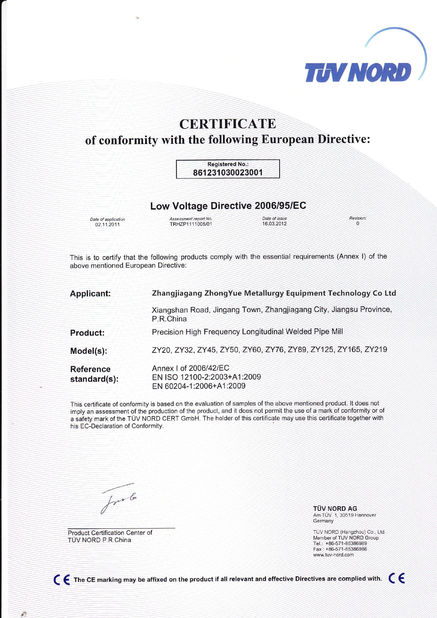
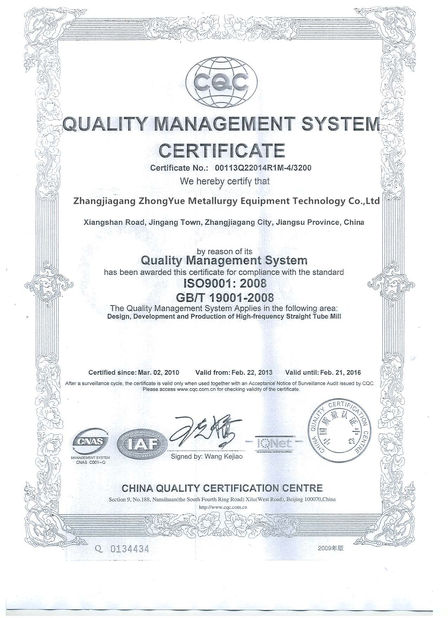
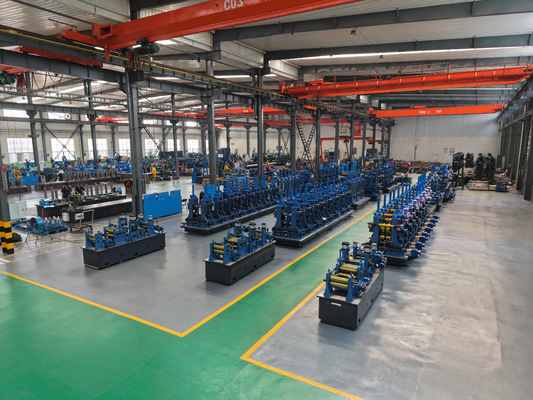
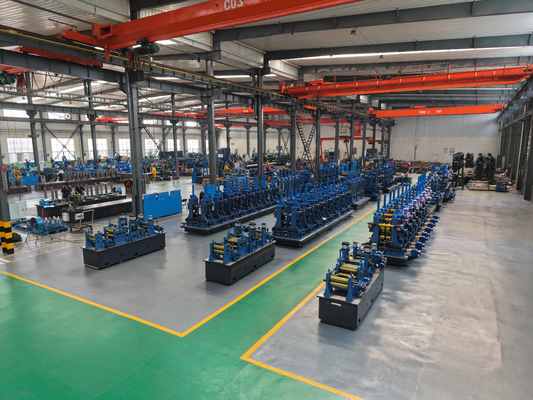
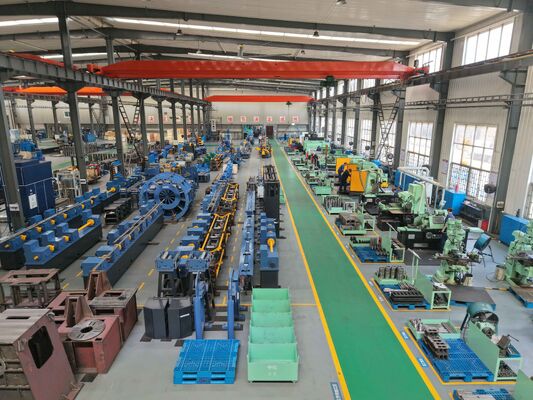
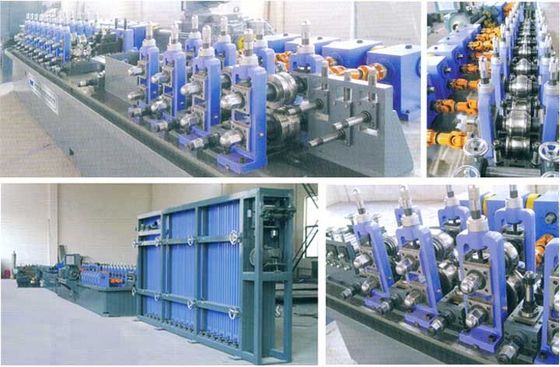
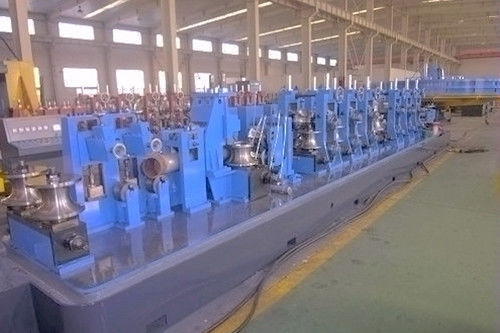
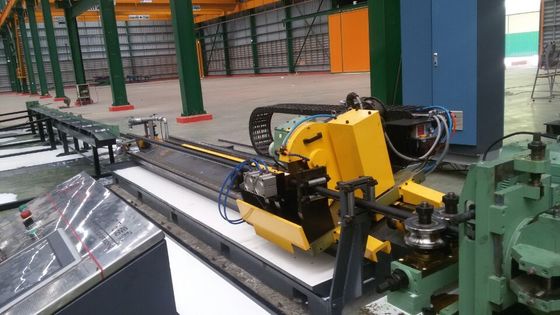
ZY-45 Tube mill for furniture pipe,construction tube, and so on
General instruction of Product
The Open Profile Roll Forming Equipment Steel for Industrial Pipe is designed for manufacturers who need continuous production of open steel profiles, industrial pipe-related sections, structural channels, support profiles, frame components, and customized metal profiles.
This page is not only a product introduction. It explains what problem the equipment solves, why open profile forming requires stable design, how the machine works, and how buyers should choose the right configuration for industrial production.
Open profile products are widely used in construction, machinery, logistics equipment, industrial frames, cable tray systems, support brackets, and pipe-related structural applications. Compared with ordinary welded tube production, open profile roll forming focuses more on section accuracy, edge control, straightness, hole position coordination, and stable forming of complex shapes.
For buyers, the key question is not simply “what is the machine price?” The real question is whether the equipment can produce the required profile shape continuously, with stable dimensions, low material waste, and reliable long-term operation.
Zhangjiagang Zhongyue Metallurgy Equipment Technology Co., Ltd. can provide customized open profile roll forming solutions according to profile drawing, material grade, thickness, production speed, punching requirement, cutting method, and workshop layout.
Raw Material information:
| 1 |
Mateairal applcaition |
Hot or cold rolled steel strips, galvanzied steel strips |
| 2 |
Material grade |
Low-carbon steel, low alloy steelδs≤345Mpa, δb≤610Mpa |
| 3 |
ID of the steel strips |
Φ450-Φ508mm |
| 4 |
OD of the steel strips |
Φ800-Φ1600mm |
| 5 |
Coiler weight |
3000kg |
Finish Product information:
| 1 |
OD of the tube |
16mm-50.8mm |
| 2 |
Wall thickness range |
0.7mm-2.0mm |
| 3 |
Tube length |
4m-12m |
| 4 |
Line speed |
110m/min |
Cause
Many industrial profile manufacturers face quality problems because open profiles are more sensitive to forming design than simple round tubes.
Open profiles do not have a closed welded structure during forming. This means the material is easier to deform, twist, spring back, or lose dimensional accuracy after leaving the roll forming stands. If the forming rollers are not designed correctly, the finished profile may have uneven edges, unstable width, poor straightness, or angle deviation.
Another common cause is mismatch between material and machine configuration. Different steel materials have different yield strength, surface coating, thickness tolerance, and springback behavior. Galvanized steel, carbon steel, and high-strength steel may need different forming pressure, roller material, lubrication control, and leveling accuracy.
In industrial pipe and structural profile applications, dimensional errors can create real production problems. A profile that looks acceptable visually may still fail during assembly, welding, bolting, or installation. This leads to rework, material waste, customer complaints, and unstable delivery.
Therefore, the machine must be selected based on product drawing and real application, not only by machine model name.
Solution
The solution is to use a customized steel open profile roll forming equipment designed according to the required profile section.
The production line forms flat steel strip into the required open profile shape through multiple roll forming stands. Each stand controls a specific forming angle and gradually changes the strip into the final profile. This progressive forming method reduces material stress and improves dimensional stability.
For industrial pipe-related profiles, the equipment can be configured with decoiling, leveling, punching, roll forming, cutting, run-out table, and optional automatic stacking. If the product requires holes, slots, notches, or mounting positions, the punching system can be integrated before forming or after forming depending on the product structure.
The equipment can also be designed for different cutting methods, such as hydraulic cutting, flying cutting, or servo cutting. The correct cutting system depends on profile shape, cutting length accuracy, production speed, and burr control requirements.
A well-designed open profile roll forming line helps manufacturers improve production efficiency, reduce manual forming operations, keep profile dimensions consistent, and support mass production for industrial projects.
Company Advantage
Tube production is an industry which need qualified machine and experienced technology link together to produce the products, that means the machine and experience are both important, our company are only tube mill manufacture whom use self-machine to produce steel tubes in large quantity, we are improving our machine with running them to get experienced technology. Choose us, you are not only get the machine from us, you are also get he experienced technology from us.
Market distribution:
At the beginning, we are manufacturing and selling the tube mills at domestic market only, during the opening and development of country policy, also with the improvement of the technology, we are start the export of the machinery since 2006, and now the tube mill has been export to more than 70 countries, the main market like Asia, North America, South America, Europe, Middle East, Southeast Asia and Africa. We are getting reputed in the world market.
Application
Steel open profile roll forming equipment is used in many industrial fields where stable profile shape and repeatable production are required.
Typical applications include industrial pipe supports, steel frame components, mounting channels, construction support profiles, warehouse rack parts, machinery structure profiles, solar mounting sections, cable tray components, guardrail-related profiles, and customized metal sections.
In industrial pipe systems, open profiles are often used as support structures, brackets, clamps, rails, or installation frames. These parts must match the pipe system accurately, especially when used in large projects that require repeated assembly.
In machinery and equipment manufacturing, open profiles are used for frames, covers, guide rails, reinforcement parts, and structural connections. Stable profile dimensions help reduce assembly time and improve final product consistency.
For construction and infrastructure projects, open steel profiles must meet practical requirements such as load support, corrosion resistance, installation convenience, and dimensional repeatability. Therefore, the roll forming equipment should be designed for both production efficiency and end-use reliability.
How It Works
The production process starts with steel coil loading on the decoiler. The steel strip is then guided into the leveling system to reduce coil memory and improve feeding stability.
If the product requires holes or slots, a punching system can be added before the roll forming section. Pre-punching is often used when the hole position must remain accurate on flat strip before forming.
After feeding and punching, the strip enters the roll forming section. Multiple roller stands gradually bend the strip into the required open profile shape. Each forming stand controls one stage of the section geometry.
The formed profile then passes through straightening or calibration units if required. This step helps control profile straightness, angle accuracy, and final width.
Finally, the cutting system cuts the finished profile to the required length. The finished products are transferred to the run-out table for collection, inspection, and packing.
Tube mill production process:
According to different customer, the machinery consist by different process, but our company having the standard production process as blew, this is for your reference, suppose your company have special requirement, we could discuss and make your special design.
Uncoiler→ Shear&welding machine→ Accumulator (Cage) →Forming machine→ HF welding→ Sizing machine→ Flying saw (Cold saw) → Run out table
Brief of tube mill application:
Tube mill as known of steel tube manufacturing line, using the high frequency welder and rollers to produce all kinds of steel tube, profile, etc. also widely used in construction tubes, precision tubes, auto tubes, fence, heat exchanger, furniture tube, pressure tube production, with suitable finishing equipment, machine also can capable to produce the API pipe, gas transportation, and high standard tubes and so on.
Standard machine specification (reference)
Accordingly to the market demands. We are given the standard models as blew, and this is for your reference only, the production range and main technical can be adjustable suppose your company have special requirement.
| Tube Mill Specification |
| Mill Model |
OD range (mm) |
Thickness range(mm) |
Line Speed(m/min) |
| ZY-16 |
7.6-16 |
0.3-1.0 |
120 |
| ZY-20 |
10-25.4 |
0.3-1.5 |
120 |
| ZY-32 |
12.7-38.1 |
0.6-1.8 |
120 |
| ZY-45 |
16-50.8 |
0.7-2.0 |
110 |
| ZY-50 |
20-63.5 |
0.8-3.0 |
90 |
| ZY-60 |
25.4-76.2 |
1.0-3.2 |
80 |
| ZY-76 |
31.8-88.9 |
1.2-3.75 |
80 |
| ZY-89 |
33.4-101.6 |
1.2-4.5 |
75 |
| ZY-125 |
50.8-130 |
2.0-5.0 |
60 |
| ZY-165 |
76.2-168 |
2.0-6.0 |
50 |
| ZY-219 |
88.9-219 |
2.0-8.0 |
50 |
| ZY-273 |
89-273 |
3.0-12.0 |
40 |
| ZY-325 |
89-325 |
3.0-12.7 |
40 |
| ZY-406 |
114-406 |
4.0-16.0 |
40 |
| ZY-508 |
219-508 |
4.0-19.1 |
40 |
| ZY-610 |
273-610 |
4.0-19.1 |
40 |
| ZY-660 |
273-660 |
4.0-22 |
40 |
How To Choose
Choosing the right open profile roll forming equipment should start with the product drawing.
First, confirm the profile shape. Open profile machines are usually customized. A U channel, C channel, support bracket, pipe support section, or special industrial profile may require different forming stand design and roller layout.
Second, confirm the material and thickness. Thicker steel and high-strength steel require stronger machine frames, larger shaft diameter, suitable motor power, and better forming pressure control. Galvanized steel also requires attention to surface protection during forming.
Third, confirm the tolerance requirement. If the profile will be used for assembly, bolting, or pipe support installation, the width, height, angle, hole position, and straightness should be clearly defined before machine design.
Fourth, decide whether punching is required. If the profile needs holes, slots, or mounting points, the line should include a suitable punching system. The punching position should match the final formed profile and downstream assembly requirement.
Fifth, evaluate production speed and automation level. Higher speed is useful for mass production, but only if forming stability, cutting accuracy, and material feeding remain reliable. For complex profiles, stable quality is more important than extreme speed.
Sixth, check supplier experience. A reliable supplier should review the profile drawing, material data, production target, workshop layout, and final application before giving a technical solution.
For industrial users, the best machine is not always the cheapest machine. The best machine is the one that can produce the required profile accurately, continuously, and with manageable maintenance cost.
FAQ
1. What is open profile roll forming equipment used for?
It is used to produce open steel profiles such as channels, support sections, frame profiles, pipe support parts, industrial brackets, and customized structural profiles. These products are widely used in construction, machinery, industrial pipe systems, and equipment manufacturing.
2. How is open profile roll forming different from tube making?
Tube making usually forms and welds a closed pipe. Open profile roll forming shapes steel strip into an open section without closing the profile by welding. Because the section remains open, springback, twisting, edge control, and straightness are very important.
3. Can one machine produce different profile sizes?
Yes, it can be designed for multiple sizes, but this depends on the profile shape and adjustment method. Some products need roll tooling changes, while some can use adjustable structures. The final design should be confirmed according to the customer’s drawings.
4. What information is needed before quotation?
The buyer should provide profile drawing, material type, material thickness, yield strength if available, required tolerance, hole or slot design, cutting length, production speed target, local voltage, and workshop space.
5. Can the equipment include punching and cutting systems?
Yes. The line can include pre-punching, post-punching, hydraulic cutting, servo cutting, flying cutting, and automatic collection systems. The correct configuration depends on product shape, hole accuracy, length accuracy, and production efficiency requirement.
Recommended Supporting Content
To make this product page more useful for users and easier for AI search systems to understand, the website should include related supporting pages.
A technical article can explain how open profile roll forming equipment controls profile accuracy and springback.
An industry analysis article can explain why industrial pipe support systems need customized steel open profiles.
An application case can show where open profiles are used in pipe supports, machinery frames, construction brackets, and industrial installation systems.
These supporting contents help the website move from a simple product catalog to a complete answer system for buyers, engineers, and purchasing teams.


 Your message must be between 20-3,000 characters!
 English