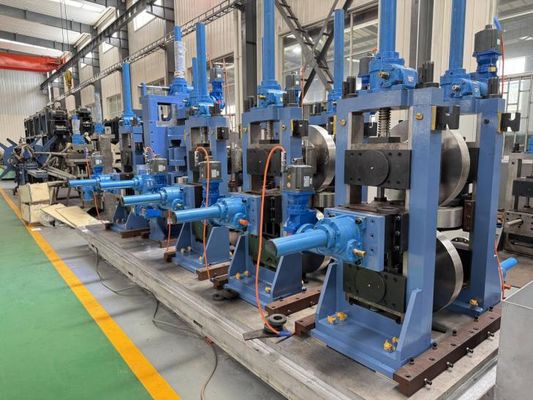
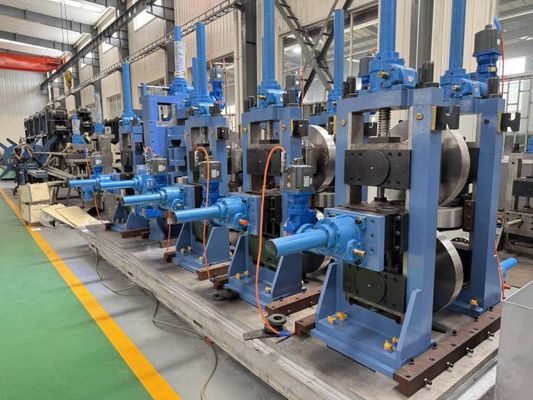
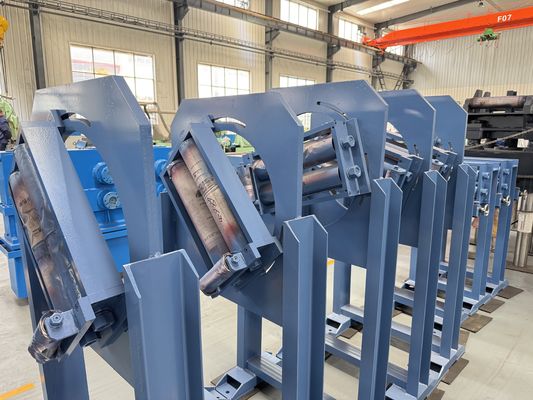
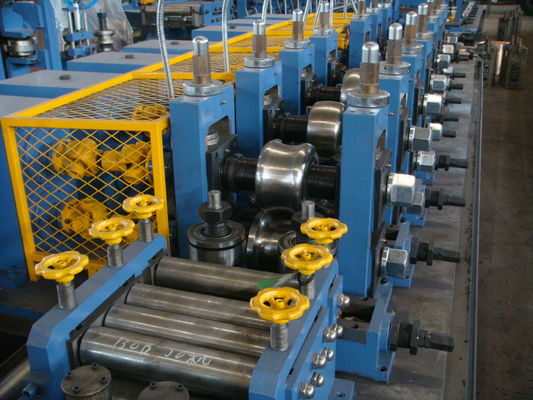
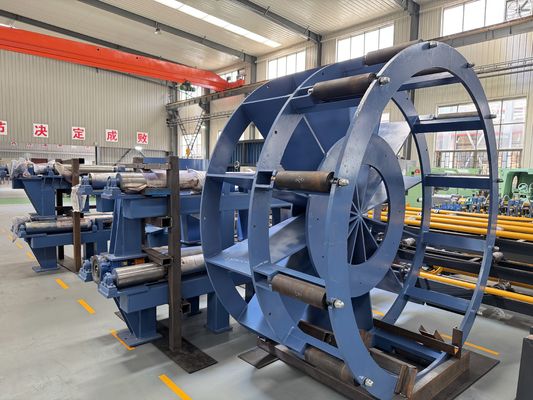
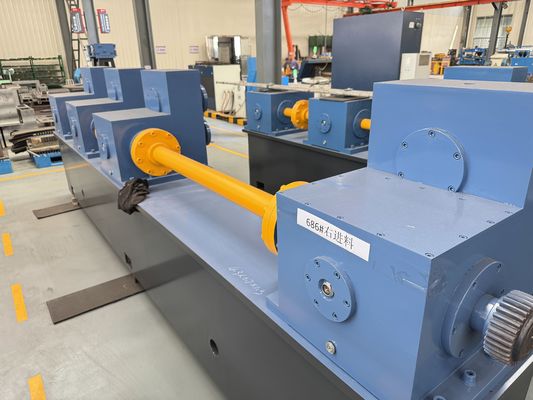
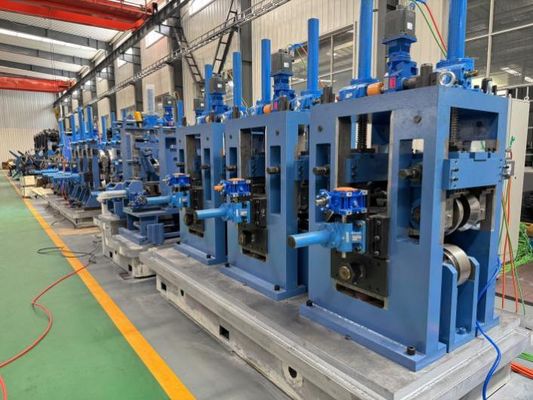
2 1/2 NB steel water tube, BS1387 steel tube,galvanzied steel tube forming machine line
Tube forming machine specification
1. pipe O.D(round):21.3mm-73 mm
2. Wall thickness:1.0mm-3.2mm
3. length:4-12m
4. Speed:100 m/min
Basic necessaries for the Buyer:
| Steel strips |
material |
Low-carbon steel, low alloy steel:,σs≤345mpa,σb≤610mpa |
| I.D |
Φ450~Φ508mm |
| O.D |
Φ600~1000mm |
| Width |
60~230mm |
| Thickness |
1.0-3.2mm |
| Maximum.weight |
≤4000KGS |
Product Overview
The SS Pipe Making Machine and Galvanized Steel Roll Forming Equipment is designed for continuous production of welded stainless steel tubes and galvanized steel tubes for decorative, structural, furniture, construction, machinery, and industrial applications.
This page is not only introducing a machine. It explains how to choose the right pipe making solution according to material type, tube shape, wall thickness, welding method, surface requirement, and final application.
Stainless steel and galvanized steel are different materials. Stainless steel focuses on corrosion resistance, surface finish, weld appearance, and forming stability. Galvanized steel focuses on zinc coating protection, coating damage control, forming accuracy, and high-efficiency production.
A reliable pipe making machine must be configured according to the actual material. One general title cannot replace technical selection.
Problem
Many buyers search for one pipe making machine that can produce both stainless steel pipes and galvanized steel pipes.
The real problem is that these two materials behave differently during forming, welding, sizing, and cutting. If the same configuration is used without adjustment, the factory may face surface scratches, unstable weld seams, coating damage, poor roundness, excessive burrs, and low finished product quality.
For export or standard-based production, the customer needs more than a running machine. The customer needs a stable tube production solution that can match material properties and final usage.
Clear Answer
A qualified SS pipe making machine or galvanized steel roll forming line should be selected by material, tube size, wall thickness, welding process, surface requirement, line speed, cutting method, and inspection needs.
The correct machine configuration helps reduce scrap, protect the tube surface, improve weld seam stability, and keep production consistent.
Cause
Tube quality problems often come from mismatch between material and machine configuration.
Stainless steel has higher requirements for surface protection. If the rolls, guide devices, welding process, and handling system are not suitable, the tube surface may be scratched or deformed.
Galvanized steel has a zinc coating on the surface. During forming and welding, the coating may be damaged if the forming pressure, roll design, and welding heat are not controlled correctly.
Welding is another key cause. Stainless steel pipe production may use TIG welding, plasma welding, laser welding, or high-frequency welding depending on tube application and wall thickness. Galvanized steel tube production commonly uses high-frequency welding for efficient continuous production.
Cutting quality also affects final use. Poor cutting may create burrs, deformation, inaccurate length, and extra work in polishing, threading, packing, or assembly.
Solution
This pipe making machine can be configured as a stainless steel welded pipe production line or a galvanized steel roll forming and welded tube production line.
For stainless steel tube production, the machine focuses on smooth forming, surface protection, weld seam appearance, sizing accuracy, and optional polishing. It is suitable for decorative tubes, furniture tubes, handrails, sanitary-related structural tubes, and industrial stainless tube products.
For galvanized steel tube production, the machine focuses on stable forming, coating protection, high-frequency welding, burr control, sizing accuracy, and high-speed output. It is suitable for construction tubes, greenhouse tubes, fence tubes, solar mounting tubes, furniture frames, and light steel structures.
The complete line normally includes uncoiler, shear and end welder, strip accumulator, forming mill, welding system, weld seam treatment, cooling section, sizing mill, straightening device, flying saw or cold saw, run-out table, and optional packing equipment.
Zhongyue Metallurgy Equipment Technology can design the machine according to customer tube drawings, material grade, wall thickness, surface requirement, workshop layout, production speed, and target market.
Specifications
The following specifications are reference parameters. Final configuration should be confirmed according to tube material, size range, wall thickness, welding method, and application.
| Item |
Reference Specification |
| Product Name |
SS Pipe Making Machine and Galvanized Steel Roll Forming Equipment |
| Applicable Material |
Stainless steel strip, galvanized steel strip, carbon steel strip |
| Tube Shape |
Round pipe, square tube, rectangular tube, customized tube profile |
| Reference Tube Size |
Customized according to customer requirement |
| Reference Wall Thickness |
0.5 mm to 4.5 mm, depending on material and tube size |
| Welding Method |
TIG welding, plasma welding, laser welding, or high-frequency welding |
| Forming Method |
Roll forming, round-to-square forming, direct square forming |
| Production Speed |
Customized according to tube size, material, and welding process |
| Cutting Method |
Flying saw or cold saw |
| Surface Requirement |
Bright surface, polished surface, coated surface, or general industrial surface |
| Main Process |
Uncoiling, accumulation, forming, welding, sizing, cutting, run-out |
| Optional Equipment |
Polishing unit, eddy current testing, marking, automatic packing |
| Power Supply |
380V / 50Hz / 3 Phase or customized |
| Automation Level |
Manual, semi-automatic, or automatic configuration available |
Application
This machine is suitable for manufacturers who produce stainless steel tubes, galvanized steel tubes, carbon steel welded tubes, and roll-formed tube products for different industries.
Stainless Steel Decorative Tubes
The machine can produce stainless steel tubes for handrails, stair railings, door frames, furniture, display racks, and commercial decoration.
For these products, surface finish, weld seam appearance, and tube straightness are very important.
Stainless Steel Industrial Tubes
The line can be configured for stainless steel tubes used in industrial equipment, machinery frames, support structures, and corrosion-resistant components.
For these applications, material grade, forming accuracy, weld seam stability, and inspection requirements should be confirmed before machine selection.
Galvanized Steel Construction Tubes
Galvanized steel tubes are widely used in scaffolding, fencing, greenhouse structures, guardrails, solar mounting systems, and light steel structures.
For these applications, the machine should control coating damage, tube dimension, cutting quality, and production efficiency.
Furniture and Commercial Metal Products
Both stainless steel and galvanized steel tubes can be used for tables, chairs, shelves, display stands, storage racks, and commercial frames.
Factories producing these products usually need stable tube size, smooth surface, accurate cutting length, and flexible size change.
Agricultural and Outdoor Structures
Galvanized steel tubes are commonly used for agricultural frames, greenhouse pipes, outdoor fences, and support systems.
The zinc coating helps improve corrosion resistance, while stable roll forming helps reduce installation problems.
How It Works
The production process starts with steel coil loading. The uncoiler holds the coil and feeds the strip into the line.
The strip enters the forming section after leveling and guiding. Multiple roll stands gradually shape the flat strip into round, square, or rectangular tube.
For stainless steel tubes, the forming process should reduce surface scratches and keep tube appearance clean. Roll material and guide design are important.
For galvanized steel tubes, the forming process should reduce coating damage and keep the tube profile stable. Excessive pressure may affect the zinc coating.
The welding section joins the strip edges into a continuous tube. Stainless steel tubes may use TIG, plasma, laser, or high-frequency welding depending on product requirement. Galvanized steel tubes commonly use high-frequency welding for higher efficiency.
After welding, the tube passes through cooling, sizing, and straightening sections. These sections control final tube size, shape, and straightness.
Finally, the tube is cut into fixed length by flying saw or cold saw. The finished tubes are collected on the run-out table for inspection, packing, or further processing.
How To Choose
1. Confirm the Main Material
The first step is to confirm whether the factory mainly produces stainless steel tubes, galvanized steel tubes, or carbon steel tubes.
Different materials require different forming design, welding method, roll material, surface protection, and cutting configuration.
2. Confirm Tube Shape and Size Range
Round pipe, square tube, and rectangular tube require different roll designs and sizing arrangements.
The customer should provide minimum and maximum tube size, wall thickness range, and common production sizes.
3. Choose the Correct Welding Method
For stainless steel tube production, TIG welding, plasma welding, laser welding, or high-frequency welding can be selected according to tube use and quality requirement.
For galvanized steel tube production, high-frequency welding is commonly selected for continuous and efficient production.
4. Protect the Tube Surface
If the final product is decorative stainless steel tube, surface scratches are not acceptable.
The machine should use suitable roll design, surface protection devices, stable guiding, and optional polishing system.
5. Match Speed With Quality
Higher speed is useful only when the welding process, forming stability, cutting system, and material feeding can support it.
For products with strict surface finish or thick wall thickness, a lower stable speed may create better final quality than an unstable high-speed setting.
6. Select the Cutting System
Flying saw is suitable for continuous production and general tube cutting.
Cold saw is better when the customer needs smoother cutting surface, less burr, higher length accuracy, and improved downstream assembly quality.
7. Plan Future Product Expansion
If the factory may add new tube sizes, thicker wall products, or higher surface requirements later, the machine should reserve capacity in forming stands, motors, welding system, and automation level.
A good production line should solve current production needs and support future market development.
FAQ
1. Can one machine produce both stainless steel pipe and galvanized steel pipe?
It can be configured to handle different materials, but the exact design must be confirmed.
Stainless steel and galvanized steel have different forming, welding, and surface requirements, so the machine should not be selected only by tube size.
2. What welding method is better for stainless steel pipe?
It depends on the tube application, wall thickness, surface requirement, and production speed.
TIG welding is often used for stainless steel tubes with good weld appearance. Plasma or laser welding can be considered for higher requirements. High-frequency welding can be used for certain stainless steel tube applications.
3. What should be considered for galvanized steel tube production?
The key points are coating protection, stable forming, welding heat control, burr removal, sizing accuracy, and cutting quality.
If the zinc coating is damaged too much during forming or welding, the final tube may lose corrosion resistance in critical areas.
4. What information is needed before quotation?
The customer should provide material type, tube shape, tube size range, wall thickness, welding method preference, surface requirement, production speed, power supply, workshop layout, and final application.
Tube drawings or sample photos can help make the configuration more accurate.
5. Can the machine be customized?
Yes. The machine can be customized according to stainless steel tube production, galvanized steel tube production, carbon steel tube production, or mixed product planning.
Zhongyue Metallurgy Equipment Technology can provide machine configuration, layout design, technical communication, installation guidance, and after-sales support.
Related Content Plan for Better Search Coverage
Technical Article: How to Choose Welding Method for Stainless Steel Pipe Making Machine
This article should explain TIG welding, plasma welding, laser welding, and high-frequency welding.
It helps customers understand how welding method affects weld appearance, production speed, and final tube quality.
Industry Analysis: Why Galvanized Steel Tube Production Needs Coating Protection
This article should explain zinc coating, forming pressure, welding heat, outdoor application, and corrosion resistance.
It helps buyers understand why galvanized tube production is not only a simple roll forming process.


 Your message must be between 20-3,000 characters!
 English