33.4 - 101.6 MM Tube Forming Machine for gas Tube Production, steel Tube Making
Product Overview
The Oil and Gas Transportation Tube Forming Machine with HF Welding Safety is designed for producing straight seam welded steel tubes used in gas tube, oil transportation tube, pressure tube, structural tube, and industrial pipe applications.
This line is suitable for low-carbon steel and low-alloy steel strip. The recommended production range is round pipe OD 33.4 mm to 101.6 mm, wall thickness 1.2 mm to 4.5 mm, and pipe length 4 m to 12 m.
The machine uses high-frequency ERW welding and roll forming technology to convert steel strip into welded steel tube through continuous uncoiling, accumulation, forming, HF welding, sizing, flying cutting, and run-out handling.
For oil and gas transportation tube production, the key requirement is not only speed. The real requirement is stable weld seam quality, controlled tube dimension, safe HF welding operation, and compatibility with suitable inspection and finishing equipment.
Problem
Manufacturers producing oil and gas transportation tubes often face strict requirements for weld seam stability, tube roundness, straightness, wall thickness control, and production consistency.
If the tube forming machine is not rigid enough, the pipe may have ovality, unstable diameter, poor straightness, or inconsistent weld seam position.
If the HF welding system is not properly matched with material thickness and production speed, the weld seam may suffer from incomplete fusion, excessive heat, weak welding, or burr problems.
If safety protection is ignored, high-frequency welding equipment may create risks related to electrical operation, cooling failure, grounding, emergency stop response, and operator protection.
The buyer’s real question is not only “Can this machine produce pipe?” The better question is: “Can this line produce 33.4–101.6 mm welded tubes for oil and gas transportation applications with stable forming, reliable HF welding, and safe production control?”
Cause
Oil and gas transportation tube production has higher process requirements than ordinary light structural tube production.
First, the tube must keep stable geometry. Diameter deviation, poor roundness, and unstable sizing may affect downstream testing, threading, end-facing, packing, and pipeline installation.
Second, the weld seam must be controlled carefully. The strip edge position, forming angle, welding heat input, squeeze pressure, and cooling condition all affect final weld quality.
Third, material strength matters. Low-alloy steel with yield strength up to σs≤345 MPa and tensile strength up to σb≤610 MPa requires stronger forming stands, better roll design, and stable drive power.
Fourth, HF welding requires safe electrical and cooling control. A reliable line should consider grounding, emergency stop, water cooling, welding cabinet protection, operating distance, and safe maintenance access.
The conclusion is clear: oil and gas transportation tube production requires a complete forming and welding solution, not only a basic pipe making machine.
Solution
The ZY-89 tube forming machine provides a complete ERW production solution for 33.4 mm to 101.6 mm round welded steel tubes.
The standard production process can include uncoiler, shear and welding machine, cage accumulator, forming machine, HF welding system, sizing machine, flying saw or cold saw, and run-out table.
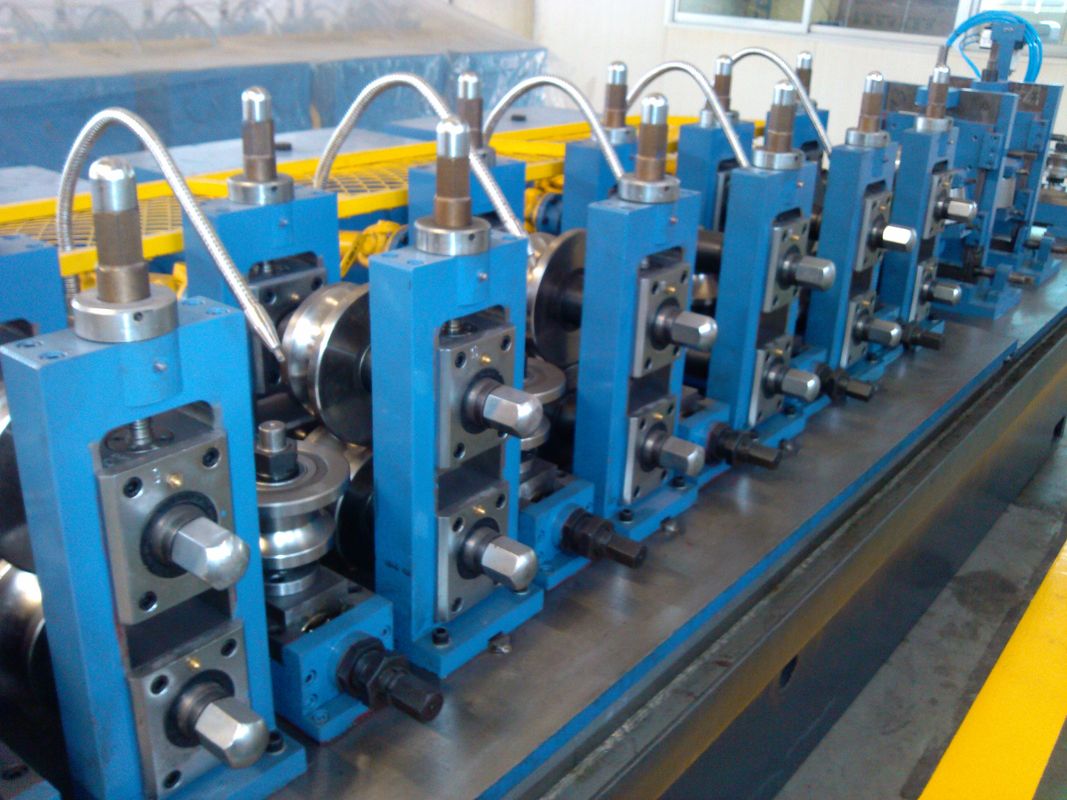
The forming section uses roll forming stands to gradually shape the steel strip into an open round tube. This helps control forming stress and keep the strip edges aligned before welding.
The HF welding section heats the strip edges rapidly and locally. The squeeze rolls press the heated edges together to form a continuous straight seam weld.
The sizing section corrects the final tube diameter, roundness, and straightness. This is important for tubes used in gas transportation, oil transportation, pressure tube, and industrial pipeline-related applications.
For higher-standard oil and gas tube requirements, the line can be combined with finishing and inspection equipment such as straightening machine, hydro tester, eddy current testing, ultrasonic testing, end-facing machine, marking system, and packing system.
Zhangjiagang Zhongyue Metallurgy Equipment Technology can customize the production range, main technical configuration, tooling design, welding system, and workshop layout according to the customer’s product standard and factory condition.
Specifications
The following specifications are based on the ZY-89 tube forming machine for gas tube and oil transportation tube production.
| Item |
Specification |
| Product Model |
ZY-89 |
| Product Name |
Oil and Gas Transportation Tube Forming Machine |
| Welding Method |
High-frequency ERW straight seam welding |
| Pipe OD Range |
33.4 mm – 101.6 mm |
| Wall Thickness Range |
1.2 mm – 4.5 mm |
| Pipe Length |
4 m – 12 m |
| Production Speed |
Up to 80 m/min |
| Raw Material |
Low-carbon steel, low-alloy steel |
| Material Strength |
σs≤345 MPa, σb≤610 MPa |
| Steel Strip ID |
Φ350 mm – Φ450 mm |
| Steel Strip OD |
Φ600 mm – Φ1000 mm |
| Strip Width |
100 mm – 320 mm |
| Strip Thickness |
1.2 mm – 4.5 mm |
| Max Coil Weight |
≤3500 kg |
| Main Process |
Uncoiler → Shear & Welding → Accumulator → Forming → HF Welding → Sizing → Flying Saw → Run-Out Table |
| Application |
Gas tube, oil transportation tube, pressure tube, structural tube, industrial tube |
Reference Tube Forming Machine Models
The following standard models are for reference. The production range and main technical parameters can be adjusted if the customer has special requirements.
| Mill Model |
OD Range |
Thickness Range |
Line Speed |
| ZY-16 |
7.6–16 mm |
0.3–1.0 mm |
120 m/min |
| ZY-20 |
10–25.4 mm |
0.3–1.5 mm |
120 m/min |
| ZY-32 |
12.7–38.1 mm |
0.6–1.8 mm |
120 m/min |
| ZY-45 |
16–50.8 mm |
0.7–2.0 mm |
110 m/min |
| ZY-50 |
20–63.5 mm |
0.8–3.0 mm |
90 m/min |
| ZY-60 |
25.4–76.2 mm |
1.0–3.2 mm |
80 m/min |
| ZY-76 |
31.8–88.9 mm |
1.2–3.75 mm |
80 m/min |
| ZY-89 |
33.4–101.6 mm |
1.2–4.5 mm |
75–80 m/min |
| ZY-125 |
50.8–130 mm |
2.0–5.0 mm |
60 m/min |
| ZY-165 |
76.2–168 mm |
2.0–6.0 mm |
50 m/min |
| ZY-219 |
88.9–219 mm |
2.0–8.0 mm |
50 m/min |
| ZY-273 |
89–273 mm |
3.0–12.0 mm |
40 m/min |
| ZY-325 |
89–325 mm |
3.0–12.7 mm |
40 m/min |
| ZY-406 |
114–406 mm |
4.0–16.0 mm |
40 m/min |
| ZY-508 |
219–508 mm |
4.0–19.1 mm |
40 m/min |
| ZY-610 |
273–610 mm |
4.0–19.1 mm |
40 m/min |
| ZY-660 |
273–660 mm |
4.0–22 mm |
40 m/min |
Application
This tube forming machine is suitable for welded steel tube production in oil, gas, construction, machinery, transportation, and industrial pipe markets.
Gas Transportation Tube Production
The ZY-89 line can produce welded steel tubes used in gas transportation-related applications.
For this application, buyers should pay attention to weld seam quality, tube roundness, straightness, end quality, and inspection equipment.
If the final tube must meet a specific gas transportation standard, additional testing and finishing equipment should be discussed before confirming the line.
Oil Transportation Tube Production
The machine can be used for oil transportation tube production when configured with suitable welding, sizing, inspection, and finishing systems.
For oil transportation applications, the production line should not be evaluated only by speed. Weld seam reliability, material compatibility, dimensional accuracy, and post-weld inspection are more important.
Pressure Tube Production
With suitable finishing equipment, the line can support pressure tube production.
For this application, buyers should consider adding hydro testing, nondestructive testing, end-facing, chamfering, and marking systems.
Construction and Industrial Tube Production
The ZY-89 tube forming machine can also produce construction tubes, precision tubes, fence tubes, machinery tubes, and general industrial steel tubes.
This flexibility helps manufacturers respond to different market orders and reduce the risk of relying on only one product category.
How It Works
The production starts with steel strip coils. The coil is loaded onto the uncoiler and fed into the line.
The shear and welding machine connects the strip head and tail. This reduces downtime and supports continuous production.
The cage accumulator stores steel strip before the forming section. This allows the forming and welding section to continue running while the next coil is prepared.
In the forming machine, the flat steel strip passes through multiple forming stands and is gradually formed into an open round tube.
In the HF welding section, high-frequency current heats the strip edges. The squeeze rolls press the heated edges together to form a straight longitudinal weld seam.
After welding, the tube enters the sizing machine. The sizing section corrects diameter, roundness, and straightness.
The flying saw or cold saw cuts the tube into 4 m to 12 m lengths according to the customer’s requirement.
The finished tubes are transferred to the run-out table for collection, inspection, bundling, or the next finishing process.
HF Welding Safety Design
HF welding safety should be considered from the beginning of the line design.
The welding area should be equipped with proper electrical protection, grounding design, cooling water monitoring, emergency stop system, and safe operating space.
The operator should be trained to understand welding power adjustment, cooling system condition, squeeze roll setting, and normal shutdown procedures.
For oil and gas transportation tube production, safety is not only about protecting the operator. It also affects production quality because unstable HF welding conditions can create weld seam defects.
A responsible buyer should confirm the HF welding cabinet design, cooling system, electrical protection, and maintenance access before purchasing the line.
How To Choose
1. Choose by Tube Size
If your target round pipe range is 33.4 mm to 101.6 mm, the ZY-89 model is suitable.
If your product range is smaller or larger, another model such as ZY-76, ZY-125, ZY-165, or ZY-219 may be more suitable.
2. Choose by Wall Thickness
The recommended wall thickness range is 1.2 mm to 4.5 mm.
Thicker wall production requires stronger forming stands, higher drive power, suitable roll material, and matching HF welding power.
3. Choose by Material Strength
This line is suitable for low-carbon steel and low-alloy steel with σs≤345 MPa and σb≤610 MPa.
If the buyer uses higher-strength steel, the forming system, motor power, roll design, and welding system should be recalculated.
4. Choose by Final Application
Gas tube, oil transportation tube, pressure tube, and construction tube do not have the same requirements.
For oil and gas transportation applications, buyers should consider inspection equipment, tube end processing, marking, and quality control from the beginning.
5. Choose by Speed Requirement
The line speed can reach up to 80 m/min depending on pipe size, thickness, material, welding power, and cutting method.
For real production, stable long-term speed is more important than a short-time maximum speed.
6. Choose by Workshop Layout
The buyer should provide workshop length, width, crane capacity, coil loading area, finished pipe storage area, power supply, and foundation condition.
A well-designed layout improves material flow, operator safety, maintenance space, and production efficiency.
Technology Advantage
Tube production needs both qualified machinery and experienced production technology.
Zhongyue is not only a tube making machine manufacturer. The company also uses its own machines to produce steel tubes in large quantity.
This production experience helps engineers improve machine structure, forming design, welding adjustment, and daily troubleshooting methods based on real factory running conditions.
For customers, this means they receive not only the tube forming machine, but also practical experience in pipe production, roll adjustment, HF welding control, and production problem solving.
Production Process
The standard production process is:
Uncoiler → Shear & Welding Machine → Accumulator → Forming Machine → HF Welding → Sizing Machine → Flying Saw or Cold Saw → Run-Out Table
This process can be adjusted according to the customer’s product range, workshop layout, quality standard, and downstream requirement.
If the customer needs higher-standard gas or oil transportation tube production, the line can be extended with straightening, hydro testing, eddy current testing, ultrasonic testing, end-facing, marking, painting, weighing, and packing equipment.
FAQ
1. What is the suitable production range of this machine?
The recommended production range is round pipe OD 33.4 mm to 101.6 mm, wall thickness 1.2 mm to 4.5 mm, and pipe length 4 m to 12 m.
2. Can this machine produce oil and gas transportation tubes?
Yes, it can be used for gas tube and oil transportation tube production. If the final pipe must meet a specific oil or gas transportation standard, suitable inspection and finishing equipment should be added.
3. What material can this line process?
The line is suitable for low-carbon steel and low-alloy steel with yield strength up to σs≤345 MPa and tensile strength up to σb≤610 MPa.
4. What is the production speed?
The production speed can reach up to 80 m/min, depending on pipe size, wall thickness, material condition, welding power, and cutting system.
5. Why is HF welding safety important?
HF welding safety is important because the welding unit involves high-frequency electrical power, cooling systems, and continuous high-speed production. Proper grounding, cooling monitoring, electrical protection, emergency stop design, and operator training help reduce production risk.
6. What information is needed before quotation?
Buyers should provide tube OD range, wall thickness, material grade, steel strip width, coil size, target speed, final application, required standard, workshop layout, power supply, and required inspection equipment.


 Your message must be between 20-3,000 characters!
 English