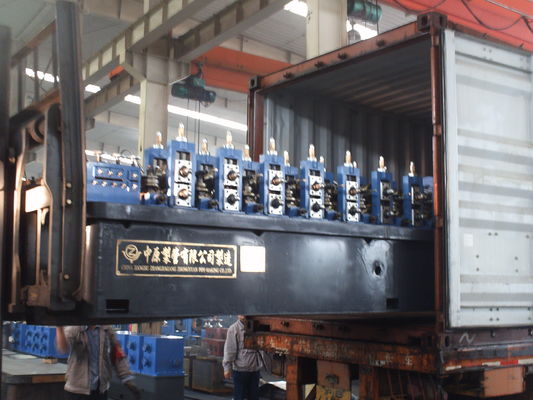
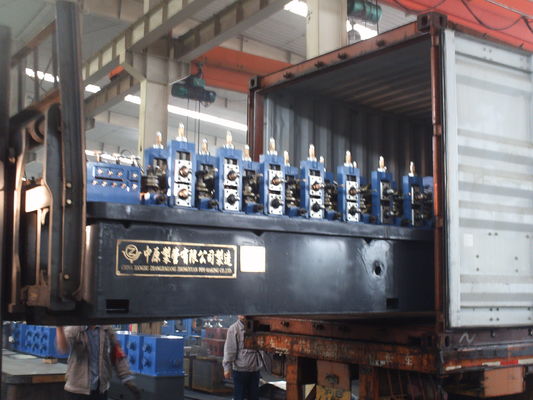
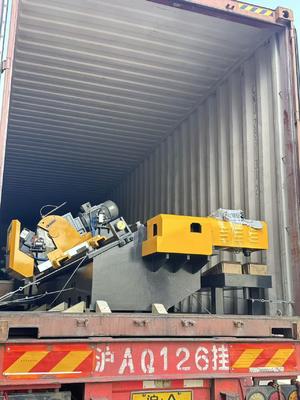
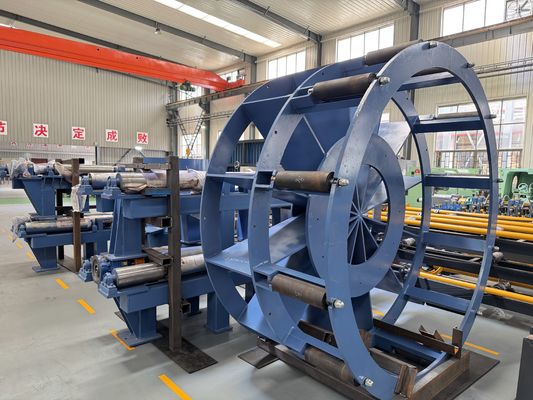
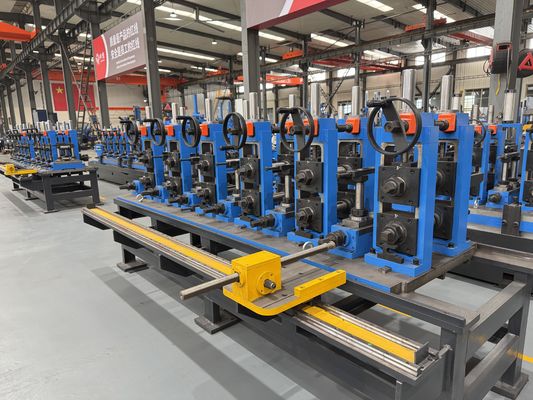
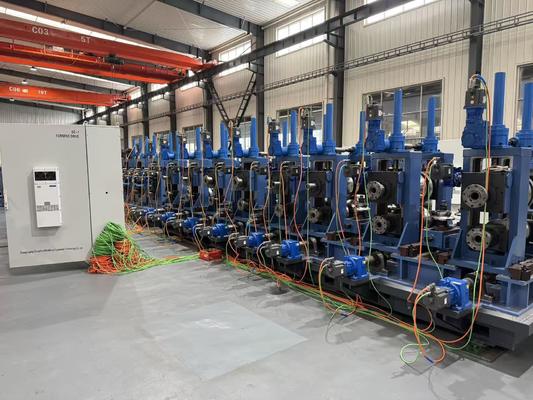
ZY16 Small diameter steel Tube making machine for heat exchanger, pressure tube
Main Technical Parameters of ZY16 Tube Making machine
| Raw material |
cold rolled steel, galvanized steel |
| Round tube outer diameter |
7.6mm-16mm |
| Wall thickness Round tube |
0.3mm-1.0mm |
| Tube welding speed |
120m/min |
Product Overview
The ASTM A53 Steel Tube Making Machine with Heavy-Duty Uncoiler is designed for producing ERW welded steel pipes from hot rolled steel strip with a reference wall thickness range of 2.0 mm to 6.0 mm.
This production line is suitable for manufacturers who need stable pipe forming, strong weld seam quality, reliable sizing accuracy, and continuous production for carbon steel pipe, black steel pipe, and galvanized steel pipe applications.
ASTM A53 is a finished pipe standard. The machine itself is not “ASTM certified,” but it can be configured to support ASTM A53-related welded pipe production when matched with proper raw material, welding control, dimensional tolerance, and inspection process.
Problem
Many pipe factories want to produce ASTM A53-related steel tubes from hot rolled steel, but they face unstable production when wall thickness increases.
Common problems include heavy coil feeding difficulty, unstable strip tension, poor edge alignment, insufficient welding heat, excessive burrs, pipe deformation, cutting vibration, and low production continuity.
For 2.0 mm–6.0 mm hot rolled steel pipe production, the key challenge is not only making the tube round. The machine must handle heavier coils, stronger forming force, higher welding load, and more demanding cutting conditions.
Clear Answer
A qualified ASTM A53 steel tube making machine for 2.0 mm–6.0 mm hot rolled steel should be selected according to coil weight, strip width, wall thickness, pipe diameter, welding power, forming stand strength, sizing capacity, cutting method, and testing requirements.
The right machine configuration helps reduce scrap, improve weld seam quality, and keep production stable under medium and heavy wall conditions.
Cause
Pipe defects in hot rolled steel tube production usually come from insufficient machine rigidity and poor process matching.
Hot rolled steel strip is often thicker and stronger than thin cold rolled strip. If the uncoiler, leveler, forming mill, and drive system are not strong enough, the strip may feed unevenly and affect the entire production line.
When the wall thickness reaches 6.0 mm, forming resistance becomes much higher. Weak forming stands may cause unstable pipe shape, poor roundness, and edge misalignment before welding.
High-frequency welding must also match the material thickness and line speed. If the welding power is too low, the weld seam may not bond properly. If the heat input is not controlled, the pipe may have excessive burrs or unstable seam quality.
Cutting is another major cause of production problems. Thick-wall pipe requires a stronger cutting system. If the saw system is not stable, the pipe end may have burrs, deformation, inaccurate length, or vibration marks.
Solution
This ASTM A53 Steel Tube Making Machine provides a complete ERW pipe production solution for hot rolled steel strip from coil loading to finished pipe cutting.
The line normally includes heavy-duty uncoiler, strip guiding and leveling system, shear and end welder, accumulator, forming mill, high-frequency welding unit, weld bead removal device, cooling section, sizing mill, straightening section, flying saw or cold saw, run-out table, and optional testing equipment.
The heavy-duty uncoiler is designed to support stable coil loading and controlled strip feeding. For 2.0 mm–6.0 mm hot rolled steel, uncoiler capacity and strip tension control are critical for continuous production.
The forming section uses multiple forming stands to gradually shape the steel strip into round pipe. Strong stand structure and accurate roll pass design help maintain stable edge alignment before welding.
The high-frequency welding system heats the strip edges and completes longitudinal seam welding through squeeze rolls. This process is widely used for ERW steel pipe production because it supports continuous operation and high production efficiency.
The sizing section controls final outside diameter, roundness, and straightness. For ASTM A53-related pipe applications, this section helps improve pipe consistency for threading, grooving, coupling, installation, and pressure-related use.
For customers targeting higher-standard markets, the line can be equipped with eddy current testing, ultrasonic testing, hydrostatic testing, end facing, marking, bundling, and automatic packing systems.
Zhongyue Metallurgy Equipment Technology can customize the machine according to pipe diameter, wall thickness, coil weight, material grade, production speed, workshop layout, and target market requirements.
Specifications
The following specifications are reference parameters. Final configuration should be confirmed according to pipe size, material grade, wall thickness, production speed, and ASTM-related testing requirements.
| Item |
Reference Specification |
| Product Name |
ASTM A53 Steel Tube Making Machine with Heavy-Duty Uncoiler |
| Pipe Type |
ERW welded steel pipe |
| Applicable Standard |
ASTM A53-related welded steel pipe production |
| Raw Material |
Hot rolled steel strip, carbon steel strip, black steel strip, galvanized steel strip |
| Reference Wall Thickness |
2.0 mm–6.0 mm |
| Pipe Shape |
Round pipe |
| Welding Method |
High-frequency ERW welding |
| Forming Method |
Roll forming |
| Main Equipment |
Heavy-duty uncoiler, accumulator, forming mill, HF welder, sizing mill, saw, run-out table |
| Uncoiler Function |
Coil loading, strip support, controlled feeding |
| Cutting Method |
Flying saw or cold saw |
| Optional Testing |
Eddy current testing, ultrasonic testing, hydrostatic testing |
| Power Supply |
380V / 50Hz / 3 Phase or customized |
| Application Fields |
Water pipe, gas pipe, steam pipe, air line, construction pipe, mechanical pipe |
Application
This steel tube making machine is suitable for factories producing ASTM A53-related ERW welded pipes from hot rolled steel strip.
Water, Gas, Steam, and Air Lines
ASTM A53-related steel pipes are commonly used for ordinary water, gas, steam, and air line applications.
For these applications, weld seam stability, pipe roundness, and dimensional control are important for safe connection and reliable installation.
Construction and Building Service Pipes
The machine can produce steel pipes for construction projects, building service systems, fire protection lines, support pipes, and general structural uses.
Stable pipe diameter and clean cutting ends help improve threading, grooving, coupling, and site installation efficiency.
Mechanical and Industrial Pipe
The line can be used to produce pipes for machinery frames, equipment supports, industrial pipe systems, warehouse structures, and fabrication projects.
For these products, straightness and weld seam consistency reduce downstream processing problems.
Galvanized Pipe Production
The machine can support black pipe production for later galvanizing or welded pipe production from suitable galvanized strip, depending on the customer’s production route.
Galvanized steel pipes are widely used in construction, fences, outdoor structures, agricultural facilities, and light steel frames.
Medium and Thick Wall Pipe Production
The 2.0 mm–6.0 mm wall thickness range is suitable for customers who need stronger pipe products than thin-wall furniture or decorative tubes.
This requires stronger forming stands, suitable welding power, and a stable cutting system.
How It Works
The production process starts with hot rolled steel coil loading. The heavy-duty uncoiler supports the coil and feeds the steel strip into the production line.
The strip is guided and prepared before entering the shear and end welding section. The end of one coil is connected with the beginning of the next coil to reduce downtime.
The accumulator stores enough strip material so the forming and welding section can continue running during coil change.
The forming mill gradually bends the hot rolled steel strip into a round pipe shape through multiple roll stands. Strong forming stands help control pipe roundness and strip edge alignment.
The high-frequency welder heats the strip edges quickly. The squeeze rolls press the heated edges together to form a continuous longitudinal weld seam.
After welding, the outer bead is removed, and the pipe enters the cooling section. Cooling helps stabilize pipe shape before sizing.
The sizing mill controls final outside diameter, roundness, and straightness. This step is important for standard-based pipe production.
Finally, the flying saw or cold saw cuts the pipe into fixed lengths. The finished pipes move to the run-out table for inspection, bundling, packing, or further processing.
How To Choose
1. Confirm the Final Pipe Standard
Before selecting the machine, confirm whether the final pipe needs ASTM A53, ASTM A500, ASTM A513, API-related requirements, or another standard.
ASTM A53-related pipe production requires attention to material, weld seam quality, dimensional tolerance, and testing process.
2. Confirm Wall Thickness and Pipe Diameter
The wall thickness range of 2.0 mm–6.0 mm requires stronger forming force than thin-wall pipe production.
Pipe diameter and wall thickness determine the mill model, roll design, motor power, welding power, and cutting system.
3. Check Coil Weight and Uncoiler Capacity
The uncoiler must match coil weight, strip width, inner diameter, outer diameter, and feeding stability.
For hot rolled steel production, a weak uncoiler can cause unstable strip tension and affect the whole line.
4. Match Welding Power with Thickness
High-frequency welding power should be selected according to pipe diameter, wall thickness, material grade, and production speed.
For 6.0 mm wall thickness, insufficient power may lead to weak weld bonding or unstable seam quality.
5. Select the Correct Cutting System
Flying saw is suitable for continuous production and general pipe cutting.
Cold saw is recommended when the customer needs smoother pipe ends, less burr, higher length accuracy, and better downstream threading or grooving quality.
6. Plan Inspection Equipment
If the pipe is used for export, pressure-related applications, or stricter project requirements, inspection equipment should be considered.
Common options include eddy current testing, ultrasonic testing, hydrostatic testing, end facing, marking, bundling, and automatic packing.
7. Consider Workshop Layout
Hot rolled steel pipe production usually requires heavier equipment and more stable foundation conditions.
Before ordering the machine, the customer should confirm workshop length, crane capacity, foundation condition, power supply, and material flow direction.
FAQ
1. Can this machine produce ASTM A53 steel pipe?
Yes. The machine can be configured for ASTM A53-related ERW welded steel pipe production.
Final compliance depends on raw material, pipe size, wall thickness, weld seam quality, dimensional tolerance, testing process, and the exact requirements from the customer.
2. Is ASTM A53 a machine standard or pipe standard?
ASTM A53 is a finished pipe standard, not a machine certification.
The machine supports ASTM A53-related production by controlling forming, welding, sizing, cutting, and inspection conditions.
3. Why is the uncoiler important for 2.0 mm–6.0 mm hot rolled steel?
Hot rolled steel coils are heavier and require stable feeding.
A strong uncoiler helps control strip tension, reduce feeding vibration, and improve production continuity.
4. Can the machine produce galvanized pipe?
Yes. The machine can produce black welded pipe for later galvanizing or produce welded pipe from suitable galvanized steel strip, depending on the customer’s process route.
The final configuration should be confirmed according to material condition and surface requirement.
5. What information is needed before quotation?
The customer should provide pipe diameter range, wall thickness range, steel grade, coil weight, strip width, target standard, production speed, power supply, workshop layout, cutting length, and testing requirements.
Pipe drawings or sample specifications can help make the quotation more accurate.
Related Content Plan for Better Search Coverage
Technical Article: How to Select an Uncoiler for Hot Rolled Steel Pipe Production
This article should explain coil weight, strip width, inner diameter, feeding tension, hydraulic expansion, and safety control.
It helps buyers understand why the uncoiler is critical for medium and thick wall pipe mills.



 Your message must be between 20-3,000 characters!
 English